The history of Fitchburg has been documented on our Fitchburg Historical Society website starting with Lorin Miller, a government surveyor who in 1833 described the eventual township of Fitchburg. While still a territory in 1837, the United States government issued patents for land which is now in the city of Fitchburg. The final first patent for Fitchburg was issued in 1860. John Stoner had the first farm in 1837 but lived in Madison. The first permanent settlers were the Vromans who established a farm in 1839 on what is now Seminole highway.
But what about the Native Americans who would occasionally camp in Fitchburg through the 1840s? In 2022, a 3,000-year-old canoe was found in Lake Mendota, in Madison. How long ago did Native Americans live at least part of the year in Fitchburg?
To answer this question, we first must define time periods. There are four time periods relevant to this issue which are depicted by the following diagram (Image used courtesy of Mississippi Valley Archaeology Center at the University of Wisconsin – La Crosse). This institute has a good description of the Native American history in Wisconsin.
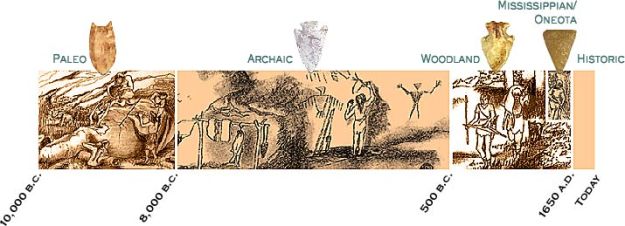
Paleoindian: 10,000 to 8.000 BC (12,000 to 10,000 BP (before present)
This time period is at the transition from the last ice age to the current interglacial Holocene epoch. Glaciers in Wisconsin retreated leaving behind moraines (mounds left behind from retreating glaciers). Dane county is noted for these moraines. The temperature in southern Wisconsin increased although it was still cooler than it is now. Trees and plants appeared providing food for large animals such as mastodons, mammoths, elk, caribou and deer. Native Americans took advantage of this new source of food and moved into southern Wisconsin. Extended families of 15 to 25 people would hunt animals using spears and made stone tools to cut and prepare the hides. They also ate limited quantiles of berries and other plants. As the plant food became scarce in one area or the cold winter came, the animals would move to a new location and the Native Americans would follow. The first panel above shows Native Americans cutting up a mammoth.
Archaic: 8,000 to 500 BC (10,000 to 2,500 BP)
The start of his time period had a climate cooler and wetter than at present. However, during the middle part of this long era the climate became hotter and dryer than now. Native Americans hunted a variety of animals with deer being the prominent prey. The tribal group still consisted of 25 to 30 people but they tended to remain at a site longer than in the past and traveled shorter distances to set up new campsites. As noted above, a 3,000-year-old canoe was discovered in lake Mendota in Madison documenting that the Native Americans had developed more complex skills. They also developed the skills to make baskets and textiles. Near the end of this era the use of cemeteries was established.
Woodland: 500 BC to 1650 AD (2,500 BP to 370 BP)
During this time period the Native Americans developed additional skills such as making pottery, growing plants and making jewelry. They were more territorial and their settlements lasted longer. Having semi-permanent settlements, they began to bury their dead in man-made mounds. This territorial development created increased tension between neighboring groups. Native Americans began to use the bow and arrow near the end of this period which was more effective at killing prey.
Historic/Post Contact: 1650 AD to Present
This time period includes contact with European trappers coming from present day Canada to the self-governed reservations found throughout Wisconsin today. As Americans populated Wisconsin in the 1700s and early 1800s the Native Americans were pushed to smaller regions. Even before Wisconsin became a state in 1848, Native American reservations were formed and continue to be self-governing communities. While largely gone from Fitchburg, there were still a few Native Americans living in Fitchburg in the early 1900s.
Native American Sites in Fitchburg
There are several sites in Fitchburg that have been excavated and shown to represent at least temporary dwellings of Native Americans. However, outside of arrow heads, tools and pottery, it is difficult to identify these sites as dwellings were made of branches and hides which decomposed over the years. These sites include:
2 Paleoindian sites and 1 additional site that overlays with other time periods
1 Archaic site that also contains other time periods
3 Woodland sites and another 2 sites that contain other time periods
4 Historic/Post Contact sites and another multi component site
Due to problems with treasure hunters even on private property, the locations of these sites are not available to the public.
For more detailed information on the History of Native Americans in Wisconsin contact the Mississippi Valley Archaeology Center
 Fitchburg Historical Society